
The Hottest New Programming Language Is English
Code.
The first thing I think of when I hear the word code is World War 2 — cryptographers, code breakers, counter intelligence sending false information through encoded messages that you know the enemy has already broken. Something hidden. Undecipherable. A secret handshake between a very small number of people and a very large amount of consequences.
A computer coder was never really that. They were actually producing very structured, logical, understandable work. It’s just that it was understandable to computers rather than most humans. A very select few who could “talk computer” and make it do magic.
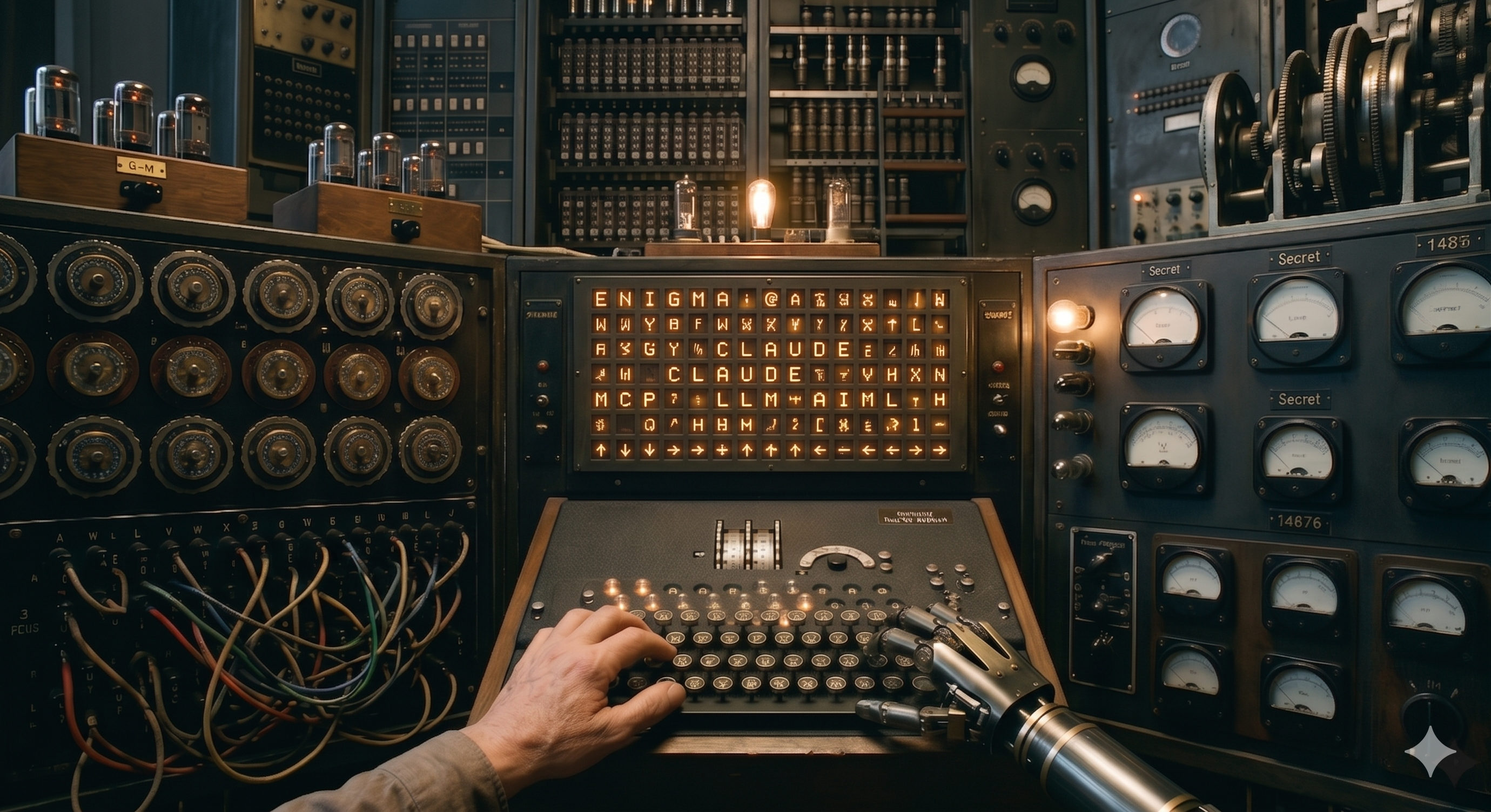
That’s changed.
In an X post on January 24, 2023, Andrej Karpathy said, “The hottest new programming language is English.” Truer words have never been spoken. We now chat with the computer and it chats back — intelligibly, thoughtfully, sometimes brilliantly [LLM]. We ask it current events questions and it fetches sources and composes up-to-date replies [RAG]. We ask it to research a topic and it breaks the task into subtasks, completes them, and synthesizes everything back into a coherent answer [agentic]. We give it interfaces to other systems and it has skills and tools to perform real digital actions in the world [MCP]. The pace of advancement is dizzying. If this technology just stopped where it is right now, society would still need about 5-10 years to fully catch up.
And yet. Some basic things, like hallucination, are still very much with us.
I interact with Claude Code regularly. In one session it feels like an incredible super genius. In the next session, it seems like the most out-of-touch buffoon. Scientists have actually isolated neurons in some models that seem most related to hallucination, and those appear correlated to temperature — the variance dial that keeps the model from giving you the same rote answer every time. Turn it up and your generations get wilder, more off-the-mark. But also more interesting. More exploratory. Sometimes it surfaces something you didn’t quite think of but suddenly realize you want to pursue.
This is, honestly, a very human thing. The journey is more important than the destination. In the journey, the traveler changes most profoundly. We’re all travelers in this global experiment right now, and the change is coming faster than most of us can process.
My personal experience with all of this is mixed — and the most interesting part isn’t what you’d expect.
On the side, I do some coding. What I’ve found is that I get so deep into it that the majority of my actual effort is in making decisions. The execution, the details, the actual writing of code — AI handles all of that. It’s gotten so frictionless that I’ll sometimes deliberately under-specify what I want, let it get things wrong, and refine it later. The act of deciding has become the primary unit of work.
At one point I hit a wall. Mentally exhausted — not from coding, but from the relentless decision-making. I think this is part of what people are starting to call AI psychosis: getting so deep into AI-assisted work that it rewires how your brain operates. Our physical bodies haven’t adapted to sedentary desk life either. Will our brains eventually need to evolve for a world where AI assistance is constant and the cognitive load never really lets up?
That question keeps me up at night more than any of the political stuff.
Though the political stuff is worth saying plainly.
Many college graduates are finding that companies aren’t hiring for entry-level positions. The logic is simple: junior tasks can be delegated to AI. I think this is shortsighted. Part of hiring the next generation is passing down what was done before — but also learning from how they see things. It’s the same reason diversity hiring isn’t charity; it’s survival. A company that lets itself become a monoculture won’t last long.
And then there’s the bigger picture. So much capital is flowing into AI, and it seems to disproportionately benefit the ultra-wealthy rather than the rest of us. I’m not the best student of history, but I know enough to know that when that kind of imbalance goes unchecked, there’s eventually a reckoning. Marie Antoinette’s most famous line was “let them eat cake” — her response to being told the people had no bread. Whether or not she actually said it, the sentiment is the point. Are the billionaires similarly that far removed?
The feeling of empowerment that AI gives you is genuinely intoxicating. I get that. I feel it too. But empowerment concentrated at the top, while everyone else scrambles to adapt, is just power with better branding.
Change is happening. That much is not in question. What’s in question is whether it’s happening for us or to us — and who gets to decide.
I don’t have the answer. But I think the fact that we’re all asking the question at least means we’re still in the conversation.
Saturday May 23, 2026